
Ask founders how long a pre-seed round takes and you tend to hear one of two answers. One is a story about someone who closed in a fortnight. The other is a number, usually "three months" or "talk to 50 investors", repeated so often that nobody remembers where it came from. Neither is much use for planning. The story is an outlier by definition, and the number is often a figure from a 2015 or 2019 dataset that lost its date somewhere along the way.
There is better evidence than either, though less of it than the confidence of most fundraising advice would suggest. Most of what is public comes from DocSend, whose software tracks how founders share pitch decks, and from a large academic survey of venture capitalists. Read together, with their dates attached, they give a reasonable picture of how long a single raise takes and how big a pipeline it needs. This piece keeps to that one process; the time between rounds is a separate question.
Where the Familiar Numbers Come From
The oldest widely quoted figures come from DocSend's first fundraising study, run with Harvard Business School professor Tom Eisenmann on a little over 200 pitch decks. As TechCrunch reported in June 2015, seed companies in that sample needed an average of 40 investor meetings and a little over 12 weeks to close, while Series A companies took 9.6 weeks and contacted an average of 26 investors.¹ The same article warned that the sample was very small and probably not representative.¹ Those numbers are now more than ten years old, and they still circulate without a date.
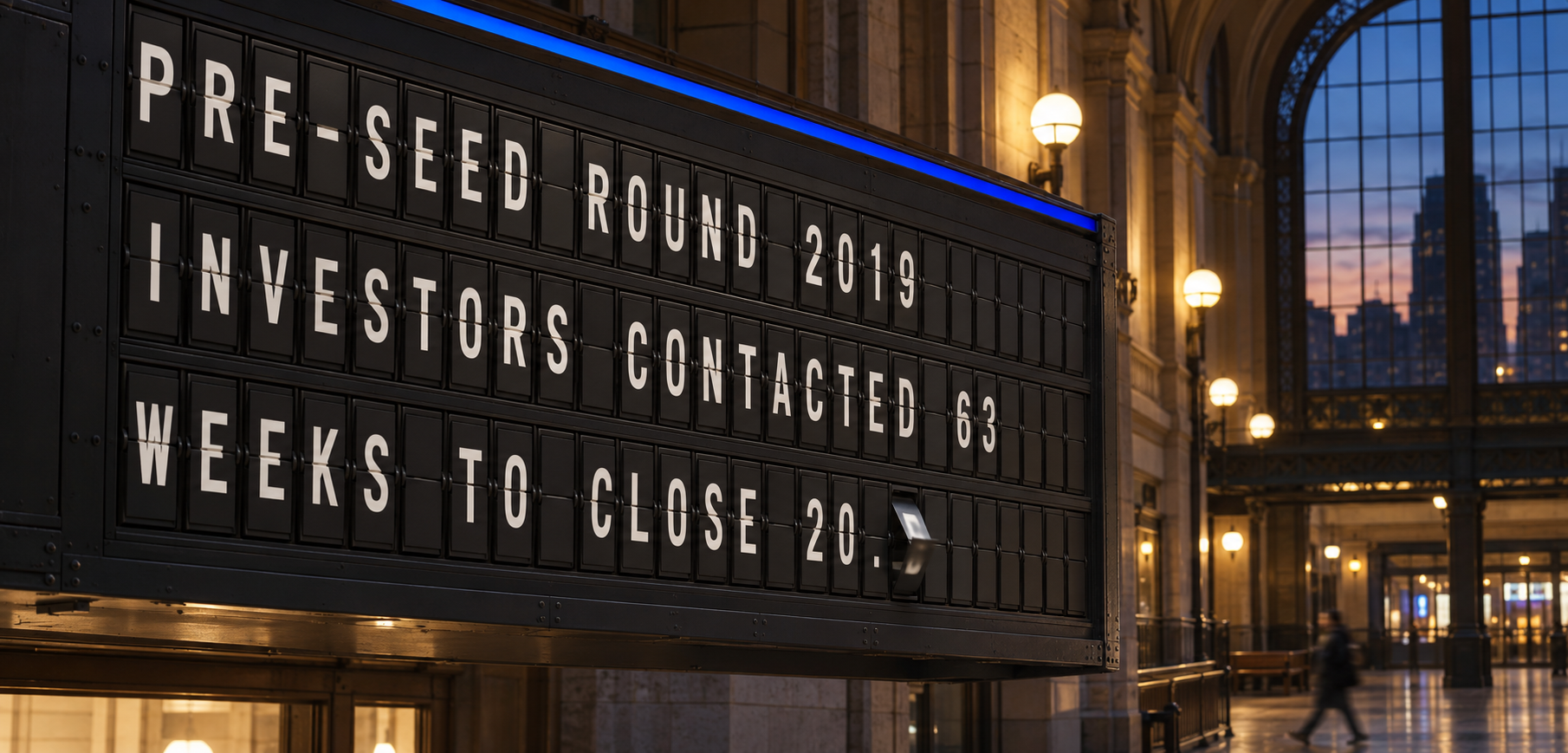
DocSend's later reports used larger samples of its own users who opted in. Its first pre-seed report, released in March 2020, covered 174 pre-seed startups fundraising in 2019. The average round lasted 20.5 weeks, founders contacted an average of 63 investors, and successful startups held 32 investor meetings.² A companion seed report on 175 startups from the same year found that successful founders contacted 77 investors on average, up from 58 in DocSend's 2015 data, and held an average of 40 meetings to close.³
A warning about vintage comes from DocSend itself. A DocSend blog post from February 2020, a few weeks before that press release, described the 2020 pre-seed research as showing an average of 54 investors contacted and 16 weeks for a successful round.⁴ The blog post presents its figures as averages for successful rounds; the press release does not say whether its 20.5 weeks and 63 investors cover every startup or only those that raised, and the full report sits behind a download form. When two figures from the same company and the same year disagree, say which one you are quoting and what population it describes.
How Long a Raise Takes
More recent DocSend data gives similar durations. Its August 2023 pre-seed release, based on more than 200 startups, said close to one third of successful pre-seed deals took 13 to 18 weeks in 2023, and that companies which failed to raise kept going for five months on average before stopping.⁵ A June 2024 release on 2023 data, again from more than 200 pre-seed and seed startups, found that all groups held fewer investor meetings over longer rounds to raise less money than in 2022. Time spent fundraising ranged from 17 weeks for all-male teams without minority members to 25 weeks for all-female teams with minority members.⁶
Converting the weeks, the averages DocSend has published for 2019 and 2023 run from 16 to 25 weeks, or roughly four to six months between first outreach and close, with close to a third of successful 2023 pre-seed rounds closing in three to four months. That is our reading across several reports, not a single published statistic, and not every report says whether it counts only rounds that closed.
The investor's own clock is shorter, because it starts later. In a survey of 885 institutional venture capitalists at 681 firms, first circulated in 2016 and published in the Journal of Financial Economics in 2020, Paul Gompers, Will Gornall, Steven Kaplan and Ilya Strebulaev found that the average deal took 83 days to close, and that the average firm spent 118 hours on due diligence over that period.⁷ ⁸ Eighty-three days is about 12 weeks for one investor and one deal. A founder's raise adds the weeks spent finding that investor, plus parallel processes that go nowhere.
Contacts Versus Meetings
The most useful single comparison in the DocSend data is between founders who raised and founders who did not. In the 2019 seed sample, founders who ended up without funding contacted 70 investors on average, against 77 for those who raised, so the gap in outreach was small. The gap in meetings was not: 15 on average for the unsuccessful group against 40 for the successful one.³ By our arithmetic, that is a meeting rate of roughly one in two for founders who raised and roughly one in five for those who did not.
DocSend co-founder Russ Heddleston wrote in 2021 that pre-seed founders in its dataset contacted 58 investors and held 30 meetings on average, and that while more contacts correlated with more meetings, the link between investors contacted and amount raised was weaker.⁹ DocSend's current fundraising guide describes a weak correlation between contacts and meetings, and an even weaker one between contacts and seed funding raised.¹⁰
The 2023 seed data went further. As TechCrunch reported from DocSend's report on that year, many seed startups secured meetings and funding by reaching out to fewer than 50 investors, while "founders who contacted more than 80 investors were a lot less successful."¹¹ The August 2023 pre-seed release put the averages at 71 investors contacted and 46 meetings secured, without saying whether that covered every founder or only the successful ones.⁵
None of this proves that contacting fewer investors causes success. A weaker company may need to contact more investors to get anywhere, so the causation could run the other way. What the data does support is narrower: in DocSend's samples, the number of investors contacted barely separated founders who raised from those who did not, while the number of meetings separated them sharply.
The Investor's Side of the Funnel
The Gompers survey also gives the funnel from the other side of the table. For each deal a venture firm closes, the surveyed VCs reported, on average, 101 opportunities considered, 28 that led to a meeting with management, 10 reviewed at a partners meeting, 4.8 taken into due diligence and 1.7 offered a term sheet.⁸ About 1 percent of opportunities become investments, and roughly one first meeting with management in 16 ends in a term sheet (our arithmetic, 28 divided by 1.7).
Two cautions apply: these are averages reported by institutional VCs across stages, not a founder's pipeline, and the sample is venture firms rather than angels. They are still the clearest published evidence we found on how often a first meeting turns into an offer.
An Illustrative Funnel
What follows is our own illustrative arithmetic, combining a DocSend-style meeting rate with the Gompers ratios. It shows orders of magnitude, not a forecast.
Start with 60 well-chosen investors. If half agree to a first meeting, as in DocSend's 2019 successful cohorts, that gives 30 first meetings. Applying the Gompers ratios from the management meeting onward (10 of 28 to a partners meeting, 4.8 of 10 to diligence, 1.7 of 4.8 to a term sheet), 30 first meetings become about 11 partner-level conversations, about 5 diligence processes and about 2 term sheets.
Now run the same 60 contacts at the unsuccessful group's meeting rate of about one in five. That gives 12 first meetings, about 4 partner-level conversations, about 2 diligence processes and fewer than one term sheet. Doubling the list to 120 would get close on paper (24 first meetings and about 1.5 term sheets), but the 2023 data on founders who contacted more than 80 investors suggests a long list is more often a symptom than a cure.
For an angel-led pre-seed round, the stages differ. There is rarely a partners meeting, and the end of the funnel is several smaller commitments rather than one term sheet. The shape still holds: most of what moves the outcome is how many of the people you approach agree to a serious conversation.
Where the Averages Mislead
The averages hide a wide spread. TechCrunch's write-up of the 2020 pre-seed report noted that while some founders raised with very little outreach, another group had to contact upwards of 100, 150 or even 200 investors.¹² The 2023 finding that close to a third of successful pre-seed rounds took 13 to 18 weeks also means about two thirds fell outside that band.⁵ At the fast end, rounds that close in days do happen, but we found no dataset that measures how often, so treat those stories as anecdote.
More outreach is also the wrong fix when the problem is the company or the price. DocSend's first pre-seed report found that over 35 percent of companies that raised had a live product in market, compared with 9 percent of unsuccessful founders.¹³ A round that is priced above what investors will pay, or a company that is not ready for its stage, does not improve with a longer list; it produces more polite declines.
There is a signalling cost too. Early investors often ask who else has seen a deal, and a round that has visibly been shopped to most of the local market can read as one that others passed on. We know of no study that measures this effect directly, but the 2023 data on very long lists is consistent with it. The samples are narrow as well, since DocSend's figures come from founders who use its software and opted into its research.
What Is Known for Europe
Not much is comparable. Every figure above comes from samples centred on the US venture market or from reports that do not describe their geography, and we found no published European dataset on investors contacted, meeting rates or weeks to close for pre-seed and seed rounds.
The closest European evidence is about conditions rather than duration. Slush's Startup Struggle Survey, which collected 607 responses from early-stage European founders in the first quarter of 2025, found that only 18 percent said it would be easy to raise funding right now if they wanted to, while 57 percent disagreed.¹⁴ Tech.eu's coverage of the same survey reported that fundraising was the top concern for 58.1 percent of founders.¹⁵ That says nothing direct about weeks or contact counts, but it gives little reason to assume European rounds move faster than the US figures.
Planning the Raise
Put together, the data supports a few planning assumptions. Budget four to six months for a pre-seed or seed process, and keep enough runway to absorb the slow end of that range. Build a list of 50 to 80 investors who back your stage, sector and geography, rather than 200 who might. Run outreach in a compressed window so that meetings overlap and conversations reach decisions at around the same time. And watch the meeting rate after the first 15 to 20 contacts: if fewer than about one in three are agreeing to meet (our rule of thumb, set between DocSend's successful and unsuccessful groups), fix the story, the terms or the targeting before you widen the list.
Relevance is also what the Marketplace inside Pynn is built around: one application puts a round in front of many relevant investors at once, with the aim of raising the meeting rate rather than lengthening the list.
Sources
1. TechCrunch, Lessons From A Study of Perfect Pitch Decks: VCs Spend An Average of 3 Minutes, 44 Seconds On Them, Kim-Mai Cutler, 8 June 2015. https://techcrunch.com/2015/06/08/lessons-from-a-study-of-perfect-pitch-decks-vcs-spend-an-average-of-3-minutes-44-seconds-on-them
2. PR Newswire (DocSend), New Data on Pre-Seed Fundraising Reveals Shifting VC Expectations, Rules of Engagement, 3 March 2020. https://www.prnewswire.com/news-releases/new-data-on-pre-seed-fundraising-reveals-shifting-vc-expectations-rules-of-engagement-301014923.html
3. DocSend, A (Brief) Anatomy of a Successful Seed Raise, Nick Frost, 10 September 2020. https://www.docsend.com/blog/a-brief-anatomy-of-a-successful-seed-raise/
4. DocSend, How to have a successful pre-seed fundraising round in 2020, Katy Jensen, 13 February 2020. https://www.docsend.com/blog/how-to-have-a-successful-pre-seed-fundraising-round-in-2020/
5. PR Newswire (DocSend), From Growth-At-All-Costs to Cost of Missing Out: DocSend Pre-Seed Report Shows Investor Shift to Long-Term Profitability and Risk Aversion, 24 August 2023. https://www.prnewswire.com/news-releases/from-growth-at-all-costs-to-cost-of-missing-out-docsend-pre-seed-report-shows-investor-shift-to-long-term-profitability-and-risk-aversion-301908433.html
6. PR Newswire (DocSend), DocSend Report Shows Funding Gap Widens, Underrepresented Founders Hit Hardest by the Venture Slowdown, 5 June 2024. https://www.prnewswire.com/news-releases/docsend-report-shows-funding-gap-widens-underrepresented-founders-hit-hardest-by-the-venture-slowdown-302164287.html
7. NBER, How Do Venture Capitalists Make Decisions?, Working Paper 22587, Paul Gompers, Will Gornall, Steven N. Kaplan and Ilya A. Strebulaev, September 2016. https://www.nber.org/papers/w22587
8. Journal of Financial Economics, How do venture capitalists make decisions?, Paul Gompers, Will Gornall, Steven N. Kaplan and Ilya A. Strebulaev, vol. 135, no. 1, 2020, pp. 169-190 (accepted manuscript, Tables 4 and 6). https://leeds-faculty.colorado.edu/bhagat/vc-decisions.pdf
9. DocSend, How to Create an Investor Strategy for Your Pre-Seed Fundraise, Russ Heddleston, 20 May 2021. https://www.docsend.com/blog/how-to-create-an-investor-strategy-for-your-pre-seed-fundraise/
10. DocSend, The Startup Fundraising Playbook, accessed October 2026. https://www.docsend.com/startup-fundraising/
11. TechCrunch, Fundraising trends for 2024: Get to the point, explain "why now", Haje Jan Kamps, 8 December 2023. https://techcrunch.com/?p=2639529
12. TechCrunch, DocSend's new pre-seed data shows how many founders you should have and how many investors you should meet, Danny Crichton, 3 March 2020. https://techcrunch.com/?p=1953158
13. DocSend, Our new pre-seed fundraising report is now live!, Russ Heddleston, 3 March 2020. https://www.docsend.com/blog/pre-seed-fundraising-report/
14. Slush, Startup Struggle Survey 2025, 2025. https://impact.slush.org/startup-struggle-survey-2025.html
15. Tech.eu, Slush's 2025 Startup Struggle Survey reveals the current state of startups in Europe, Cate Lawrence, 7 May 2025. https://tech.eu/2025/05/07/insights-from-slushs-2025-startup-struggle-survey/